
 Trends and New Developments in ELT
The course took place from 3-14 August 2015, in NILE, Norwich, England, and it was intended to give theoretical insights and ideas for practical application of new developments in ELT. Tom Sarney was the course coordinator, but three other teacher trainers worked with us in different aspects of language learning, namely Maria Heron, Griselda Beacon and Nicole Robinson.
It involved face to face input, practice and discussion of activities, reading and research and culminated in the teaching of a short activity based on the course content and the presentation of a rationale which can be used in the context participants are working in. Tom Sarney, asked for discussion at the end of each presentation and evaluated it at the end. The whole context of the course lead to knowing the participants better and to the exchange of useful ideas.
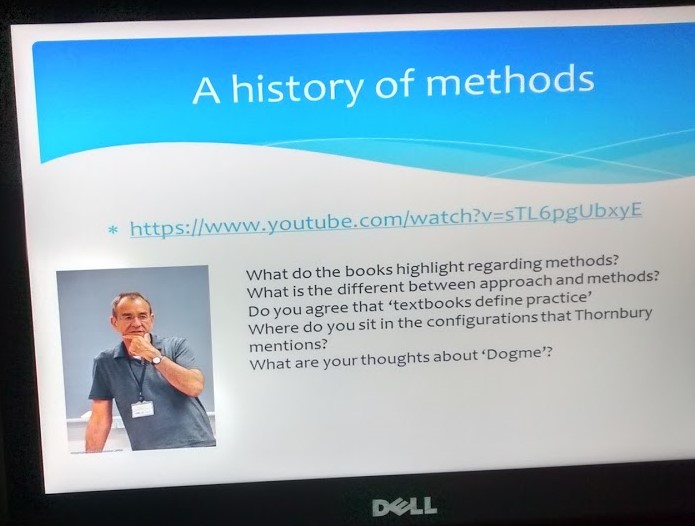
The course activities started by the history of methods and the understanding of how things have been changing over the years in FLT from the Grammar Dictation Method in the 1900s to the Communicative approach and the Dogmae and Demand High nowadays’ approaches.
There was a comparison between the previous paradigm and the current one, from cultural and linguistic homogeneity to cultural and linguistic heterogeneity, from the native speaker model to not only a model to be applied in all contexts, from accuracy to fluency, from the construction of identity that was seen as an individual process without the interference of social, political, cultural factors, among others, to cultural and linguistic activity seen as a social process through the interaction with others in multiple and diverse contexts, and from the learning of a foreign language seen as channelling access to the other culture to the learning of a foreign language unveiling new cultural spaces that resignify students own culture and language.
All activities were based on equipping the students with 21century skills and among the main trends and developments, there were Technology, Creativity and Flow, Intercultural Learning, Motivation, Eclecticism, Flipping Classroom, CLIL, TBL, Critical Thinking, Noticing, Multisensory Learning, Dogmae, Demanding High, etc.
This course totally fulfilled my expectations once I came home with a set of new ideas on how to work with my students. Besides, I will organise a workshop for my colleagues at school and invite other schools so that they can also apply these new strategies learned during the course in their classes.
Besides the activities on the schedule, there were workshops to be attended, namely Affective or Effective learning by Martin Parrott on the first Wednesday afternoon and, chosen among several others, Art in the language Classroom by Griselda Beacon. The cultural activities included in the programme were Ghost tour of Norwich, day trip to Cambridge, day trip to Southwold and Norwich Guildhall Tour.
The participant: Margarida Marques
Tendências e Novos Desenvolvimentos no Ensino da Língua Inglesa
O curso decorreu de 3 a 14 de agosto de 2015, no NILE em Norwich, Inglaterra e teve como objetivo fornecer conhecimento teórico e ideias para aplicação prática dos novos desenvolvimentos no Ensino da Língua Inglesa. O coordenador do curso foi Tom Sarney, mas três outros professores trabalharam connosco em diferentes aspetos da aprendizagem das línguas, nomeadamente Maria Heron, Griselda Beacon and Nicole Robinson.
Envolveu input presencial, prática e discussão de actividades, leitura e pesquisa culminou na lecionação de uma atividade baseado no conteúdo do curso e a apresentação de um racional a ser usado no contexto em que os participantes se encontram a trabalhar.Tom Sarney, solicitou discussão no final da apresentação no final avaliou a apresentação.Todo o contexto do curso levou a um melhor conhecimento dos participantes e à partilha de boas ideias.
As atividades do curso iniciaram-se pela história dos métodos e pela compreensão de como se têm vindo a alterar ao longo dos tempos no Ensino das Línguas Estrangeiras, desde o método de Gramática Ditada nos anos 1900 até Abordagem Comunicativa e ao Dogmae e Demand High de hoje em dia.
Comparou-se o anterior paradigma com o atual, ou seja, de um paradigma de homogeneidade cultural e linguística a um paradigma de heterogeneidade cultural e linguística, do modelo de falante nativo a não apenas um modelo a ser aplicado em todos os contextos, de uma abordagem de correção a uma abordagem de fluência, da construção de identidade que era vista como um processo individual sem a interferência de fatores sociais, políticos e culturais, entre outros, à atividade cultural e linguística vista como um processo social através da interação com os outros em múltiplos e diversos contextos, e da aprendizagem de uma língua estrangeira como dando acesso a outra cultura à aprendizagem de uma língua estrangeira que dá acesso a novos espaços culturais e outro significado à própria cultura e língua dos alunos.
Todas as atividades se basearam em equipar os alunos com as competências do século XXI e, entre as novas tendências e desenvolvimentos, estiveram a Tecnologia, a criatividade, a Aprendizagem Intercultural, a Motivação, o Ecletismo, Flipping Classroom, CLIL, Aprendizagem por Tarefas, Pensamento Critico, Noticing, Aprendizagem Multisensorial, Dogmae, Demanding High, etc.
Além das atividades do programa foram apresentados workshops, nomeadamente Affective and Effective Learning por Martin Parrott na quarta feira da primeira semana e, escolhida de entre outras, A Arte na aula de Língua por Griselda Beacon. A parte cultural incluiu um Ghost Tour de Norwich, um dia de viagem a Cambridge, um dia de viagem a Southwold e um Norwich Guildhall Tour.
A participante: Margarida Marques